

How I coach
People come to me stressed, confused, stuck in their own heads.
They leave knowing exactly what to do next. And believing they can do it.
That’s the work.
I’ve sat on both sides of the table.
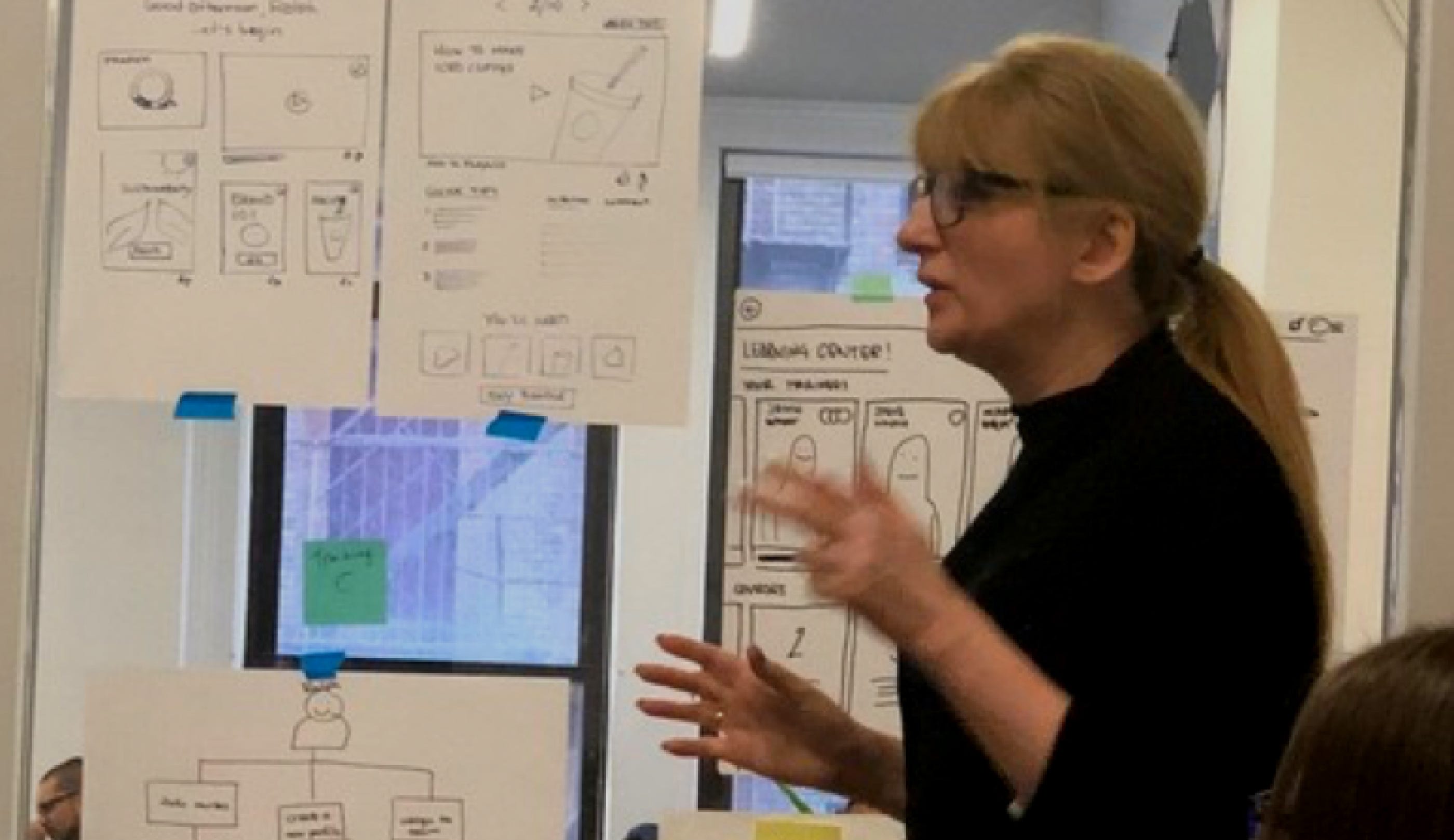
Most recently, I was VP of UX at JPMorgan Chase. Before that, American Express. In between, I built and led a large international design team at a Swiss tech startup. I have worked inside agencies, consulting environments, product teams, enterprise organizations, and startups.
I have also helped 2,400+ designers and design leaders understand their strengths, navigate career stalls, prepare for bigger roles, reframe their work, and stop confusing being useful with being seen as ready for the next level.
I’ve made the hiring decisions. I’ve sat in calibration meetings and watched names get crossed off for reasons nobody said out loud. I’ve decided who got the high-stakes project and who got passed over. I know what gets said about you when you leave the room.
That’s what I bring.
“The work should speak for itself”…but it doesn’t.
Excellent work stays invisible unless someone makes it visible.
Capability is table stakes. Someone still has to choose you. Recommend you. Fight for your promotion when you’re not in the room.
Every one of those moves is a small bet with their reputation. I teach you how to make that bet feel safe.
You can’t see yourself clearly.
You’re too close. You’ve lived every decision, every tradeoff, every context.
That’s exactly why you can’t hear what the room hears in the first 30 seconds.
That gap - between how you think you’re coming across and how you’re actually being read by the hiring manager, the VP, the panel that decides your future - is what’s holding you back (Not your skills, or your experience, or your portfolio)
And you can’t close it alone.
You need someone who’s been in those rooms, made those calls, and can tell you what’s landing and what’s killing you.
Most career advice teaches you to blend in.
“Be a team player.” “Avoid friction”. “Take the feedback”.
But careers accelerate for people who create the right kind of tension.
Challenge “sacred cows”. Surface the conversations everyone avoids. Ultimately, make yourself impossible to overlook.
If you’re not making at least a few people uncomfortable, you’re probably standing still.
AI gives you possibilities. I give you the read.
Ask Claude or ChatGPT to rewrite your resume, and you’ll get something polished and generic.
Ask it to prep you for interviews and you’ll get solid answers that sound like everyone else’s solid answers.
Here’s what it can’t do:
It can’t tell you that your “leadership” story sounds like you got dragged into a mess, not that you “chose to lead”.
It can’t tell you that your portfolio pitch loses the room at slide 6, because you’re still explaining what you did instead of why it mattered.
It can’t read the political subtext of the role and tell you what the hiring manager is actually afraid of.
It can’t catch you underselling yourself in a way so subtle you’d never notice, but a VP would.
It can’t push back when you’re self-sabotaging and calling it “being practical.”
AI gives you frameworks. A coach who’s been in the room gives you the read.
Who this is for
→ The overlooked senior (or lead/staff/principal).
You’ve been “almost ready” for 3 cycles.
You get the hard projects but not the title. Yet, someone less experienced gets promoted just because they sound like a leader in the room.
→ The startup director who can’t break into enterprise.
You’ve held the title and run the team.
But your story still sounds scrappy.
Enterprise hiring managers don’t see someone who can command a 200-person org on day one. They see risk.
Both problems have the same root: you’re being positioned wrong. And you can’t reposition yourself. But I can help you do exactly that.
So what happens in a session?
I tell you the truth.
Like where your resume loses them, or where your interview answers sound under-leveled. Or where your portfolio pitch makes the panel check out.
What you’re signaling that you don’t realize you’re signaling.
Then we fix it.
Not as in “tell your story better” → storytelling is performance.
We reposition the story entirely, so the next room reads you the way you’ve been waiting to be read.
One session is frequently enough.
Most clients don’t need ongoing coaching.
They need someone to name the thing they couldn’t see, fix the positioning, and send them back sharper.
If that takes 45 minutes, we’re done in 45 minutes.
I don’t let clients sit in their problems. We move.
The math
Every month you stay invisible costs you.
Like that role that went to someone else. Or that title bump that didn’t happen. Or that negotiation you had no leverage for.
The confidence bleeding out after another “we went with someone else.”
One session is usually $449–$549. Staying invisible for another year costs six figures.
Speaking of the sessions…
I only coach on Wednesdays. Sometimes spots fill weeks out.
A few popular ones-
Ask Me Anything - Career Strategy Session (45 min) → $449
FREE-FORM career session. Bring your questions, and we'll work through them together.
Mock Interview (45 min) → $499
A realistic mock interview for the exact role you're targeting. I ask the questions senior leaders actually use, you answer under real pressure, and I tell you straight where it landed and where it broke (and how to fix it).
Director Interview Prep for ICs (60 min) → $549
[Reframing your IC work as Leadership] You're interviewing for a Director role and you've never held the title for. This session tests your stories so you walk in sounding like a leader, not a senior IC who got lucky.
You have the experience. The room just doesn’t see it yet. That’s fixable.
Testimonials

FAQs
→ How is this different from other career coaching?
Most coaches teach you to “tell your story.” I reposition how you’re being read. Storytelling is performance; positioning is strategy. I’ve sat in the rooms where these decisions get made. I know what gets said about you after you leave.
→ I’m not sure which session to book.
If you have a specific interview coming up, book the relevant prep session. If you’re not sure what’s holding you back, start with the AMA, we’ll figure it out together.
→ What if I just need help with my resume or LinkedIn?
We can cover that in an AMA session. Fair warning: I’ll probably tell you the problem isn’t your resume. It’s how you’re thinking about what goes on it.
→ Do you offer ongoing coaching?
Yes, for a small number of clients - weekly or bi-weekly sessions that build momentum. Ask me about it during your first call.
→ What if I’m not ready?
Start with the newsletter. Read the archive. Do the work yourself. When you hit the ceiling -when you realize you can’t see what the room sees - you’ll know it’s time.
→ What’s your cancellation policy?
Let me know you can’t make it 24 hours before your session, and we’ll move you to another Wednesday. No-shows are not refunded.
Not ready for 1:1?
The newsletter covers the same territory→ visibility, influence, how power moves inside organizations.