


Everything you’ve been told about “speaking up at work” is wrong.
Yeah, I know how that sounds, so stay with me and I’ll explain.
All those “just be more confident” posts were written by someone describing a feeling. Or, “practice your executive presence”, “own the room”, “be bolder in your next review…”
I bet, you’ve read hundreds of them (and probably saved a few ;)
Don’t get me wrong, I’m not anti-confidence. And I’ll show you exactly where it belongs later in this issue (spoiler: it’s step four, and it’s probably not where you think).
But all the headline advice, “you just need to believe in yourself more,” is, in my ex-VP opinion, the most expensive piece of career advice in our industry.
Because it’s aimed at the wrong thing entirely, and you’ve been failing at it for years while doing absolutely nothing wrong.
Moreover, I did not discover this. Two researchers did, and I only ran into it years after I’d already watched it play out from the other side of the table.
And now I’m not handing you a formula, but a pattern I saw over and over as the VP sitting in the room deciding who got the bigger scope.
First, the receipts. And they’re not mine.
You know, stock analysts rate companies, right? “Buy”, “hold,” “sell”. This kind of stuff.
In practice they almost never say sell.
Everyone in finance knows this.
Two researchers went looking for who does say it.
They pulled the ratings of hundreds of Wall Street analysts, sorted them by standing in the field, and checked who was willing to put out a negative call.
The answer was the stars and the nobodies.
The most respected analysts said sell. AND the unranked ones nobody had heard of said sell.
The people in the middle, the good ones, the ones on their way up, almost never did.
Then they checked whether it was about being right.
It was not!
Forecast accuracy had no relationship at all to whether an analyst would say sell. So the people staying silent were not less sure.
They were less safe.
Then the same researchers looked at Silicon Valley law firms over 50 years and asked which ones would announce a family law practice (like divorce work, unglamorous and lower prestige stuff, but perfectly good business)
The most elite firms did it. The bottom firms did it. The firms in the middle would not touch it.
Two completely different industries…but same shape both times, hmmm.
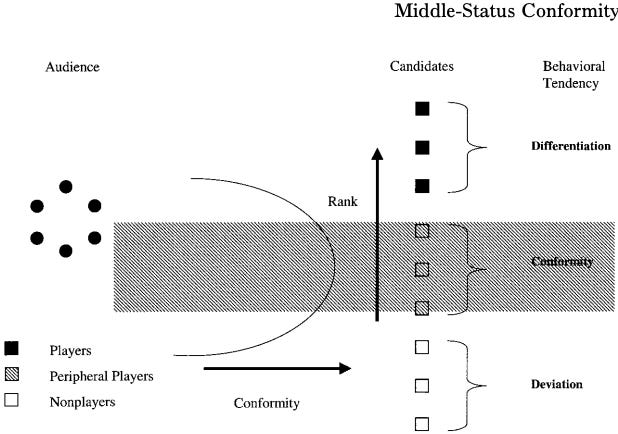
The middle is the scariest seat in the room
So now let’s see the finding underneath both.
First, think of any group worth belonging to.
There are 3 places you can stand.
Inside it.
Outside it.
Right on the line.
Inside, you’re SAFE.
You can do an odd thing and stay who you are. A partner at an elite firm takes a divorce case and nobody starts wondering whether the firm is slipping.
Outside, you’re FREE.
Nothing you do changes your standing, because you had none. You can say sell all day.
The line is the BAD place.
On the line, you’re close enough to see the inside.
You’re also close enough to fall out.
So you spend your days proving you belong.
(you do the accepted thing, you do it well, you do it every single time)
The researchers have a phrase for it → Middle-status actors are anxious because they aspire to a position AND fear losing the one they have.
Both at once, and that’s, my friends, is the whole engine.
Now, let’s look at your position:
If you’re Senior, or Lead, or Staff - you are standing on the line.
You can see the level above you, you’ve watched people get cut.
And every week you make a 100 tiny choices about whether to say the thing, push the thing, take the odd project, disagree in the meeting.
And you keep choosing the accepted version.
That is NOT who you are, that’s where you are standing.
Watch how fast it compounds
People thinks this is a “slow burn”. NOPE.
🗓️ Month 1 to 3:
You’re pleasant, reliable, easy. People like working with you. Nobody has a single complaint.
🗓️ Month 4 to 9:
“Easy to work with” hardens into the sentence they use to describe you. “She’s great. Really solid.” Notice what’s missing from that sentence? (hint: it’s any mention of what you think)
🗓️ Month 10 to 18:
That sentence is what your manager now repeats in the rooms you’re not in. The “who do we trust with the bigger scope” conversation. And “really solid” loses to “has a point of view” every single time.
If the phrase “rooms you’re not in” made your stomach drop a little, you’re being evaluated in meetings you weren’t invited to is about exactly what gets said in them.
Why every “confidence fix” you tried did nothing
If you’ve been reading this newsletter a while, you’ve probably tried things.
You practiced speaking up, or read about executive presence or told yourself to be bolder next time.
Probably, none of it held. Like it may have worked for a week …and then you went back to “old ways”.
So you concluded something was wrong with you.
Nothing is wrong with you!!
You were treating a position like it was a personality.
Regular confidence advice is aimed at a feeling.
This is not a feeling! It’s actually a rational response to standing on a line, and it will not budge for a pep talk, because the line is still there when the pep talk ends.
(I wrote the closest thing to this a while back, why talented UX leaders stay stuck, and there’s a diagnostic in it. Read it after this one, in that order. The seat first, THEN the authority)
It also explains a stack of other things you’ve read here and nodded at without knowing the cause:
Why being trusted with work caps your growth instead of raising it.
Why saying no is so hard for designers, even when you know it works.
Those are all the same thing. They are all the middle seat.
The person who is agreeable, reliable and never the problem is somebody standing on a line, doing exactly what standing on a line makes people do.
The trap inside the trap.
The behavior that keeps you safe on the line is the same behavior that keeps you on the line.
Nobody gets moved up for being agreeable.
They get moved up for having a view.
And having a view is a risk, so the thing you’re avoiding in order to protect your position is the only thing that would ever change it.
That’s why good people sit at Senior for 4 years. Not for lack of effort or skill. The work is usually excellent.
They’re running a strategy that is correct for staying and wrong for moving, and nobody ever told them there was a difference.
So what do you actually DO about it?
Here’s the whole play, and you can start it this week without me.
Step 1:
Check that you’re actually in the middle seat
4 questions, answer them fast, don’t think
Can you name the level above you and picture exactly who’s in it?
Have you seen someone at your level get cut or pushed out in the last two years?
In the last month, did you soften or drop something you believed because of how it would land?
Would people describe you as easy to work with before they described what you think?
3 or 4 yeses means you’re on the line (and it’s fine, becuase it’s where most good people are)
Step two:
Pick ONE thing
Don’t go for “be bolder in general.” IT WILL fail in a few days, a week max. I’ve watched it fail approximately one thousand times.
You get 1 visible thing this quarter. One.
Here’s how to pick it:
It has to be seen.
If nobody watches you do it, you get none of the return.
It has to be about judgment (NOT taste)
Disagreeing about a color is noise. Saying a project is aimed at the wrong problem is a view. So only one of those makes people think differently about you. (If you can’t feel the line between the two yet, the 7 questions Directors ask that Senior ICs don’t is the fastest way to hear it.)
It has to be survivable.
Ask the plain version: if this goes badly, what actually happens? If the honest answer is “it’s awkward for two weeks,” that’s survivable. If the answer is “I lose my main advocate,” pick something else.
It should be something you already believe.
Do not manufacture a position to look interesting. You already have 3 or 4 things you think and don’t say. Use one of those. (You thought of one just now. THAT one :)
Step 3:
Say it in a room with people in it
Not in the one-on-one. That’s the safe version and it’s exactly why the safe version doesn’t work.
It needs to be said in the meeting. Or go into the doc that circulates. Or the review where the decision is actually being made.
Step 4:
Do not chase the outcome.
You’re not doing this to win the argument. You might lose the argument.
You’re doing this to change what people believe about you, which changes whether you win the next one.
Watch who follows up afterwards and what you get invited to over the next six weeks.
That’s the return.
Step 5:
Then stop
You can do it ONLY 3 times a year. THREE.
People who go from silent to constantly disagreeing won’t be read as senior.
They be seen read as difficult in the bad way, which is a worse seat than agreeable.
The scarcity is the entire point.
3 well-chosen views a year from someone who is normally reasonable land 10 times harder than a weekly opinion from someone who always has one.
What to expect?
2 things.
It will feel much worse before you do it than during. The line is mostly imaginary.
The people who moved up are NOT braver than you, they’re standing somewhere else.
You’ve been protecting a position that was never going to be enough fro YOU!
The “good stuff”
I could stop right here and you’d have the reframe. Just run steps 1 through 5, and you’ll be fine.
BUT “Pick one thing” could be easy to write down on a Sunday, then may become completely useless on a Tuesday when you have 11 things you believe + no idea which one is the “survivable” one, and a VP whose meeting is on Thursday…
So Wednesday’s paid issue is one of these built end to end, with a real Lead designer, who spent 4 years in the same seat.
For less than the price of one fancy coffee with a pastry, paid subscribers get:
The 11 things the Lead believed and had never said, written out, unedited
Which one we picked, and exactly why we threw out the other 10 (2 of them were career-enders and she couldn’t tell)
What she actually said, word-for-word, in a room with her VP in it
The 6 weeks after, including the part that went off-track and what we did about it
Where she is now, 7 months later, plus the one line in her review that proves it was the mechanism and not luck
The “Stand Out” List, the one-page Google doc we scored her “11 things” on. Yours to use on your own “11 things”(or as many as YOU have)
The “Sentence Swap” Sheet, another Google doc if yours to copy, 20 sentences that make you sound less senior than you are and what to replace them with
The entire archive of every paid issue, instantly unlocked
The issue is called You get to be difficult three times a year, it’ll be out Wednesday, August 19th (and it’s using the process I charge big bucks for in 1:1 sessions)👇
Talk soon!
📌 Stay sharp between issues
→ Follow me on LinkedIn for unconventional UX career plays
→ Check my book with practical mentorship frameworks for senior UXers
→ Email with collab ideas, guest writing, and more
→ Reach out if you want to sponsor this newsletter trusted by designers and leaders scaling their careers across Fortune 500s, agencies and high-growth AI startups.