

He sent 300 applications. The problem was never the applications.
Laid off, sprayed the market, and slowly stopped believing he could land anything.

👋 Hi friends, new and old, I’m Marina Krutchinsky, founder of UX Mentor Diaries. A few months ago I left my VP of UX job at JPMC to fully focus on coaching designers and sharing what's actually working for them - in this newsletter - in case it helps you too.
This is the first in a new series, Inside the Session, where I take you inside one real coaching situation, step-by-step and start to finish, with the actual built.
[Details are changed to protect the client; the dynamics are exactly as they happened.]
For more: Coaching | Testimonials
The intake
He came to me having already given up, he just hadn’t said it out loud yet.
A director. 5 years at one company. He’d been hired as a Lead, promoted to Director 3 years in, and spent those last 2 years doing the job well - building the team, setting the bar, owning a product line that mattered.
Then his skip-level, the person who’d backed him from the start, left for another company.
6 months after that, a reorg came through and his role was cut. Not his work, his role.
By the time we talked, he’d sent out somewhere north of 300 applications.
He couldn’t give me an exact number, which tells you everything about how he was sending them. Spray and pray.
Every director listing, every “Head of,” a few senior IC roles he didn’t want “just in case.”
He’d copy-paste the same resume, swap the company name in the cover letter, hit submit, and feel slightly better for about 90 seconds.
The replies were either nothing or a templated no. Just 2 interview invites followed by silence.
And 4 months of that does a specific kind of damage.
He wasn’t panicked anymore. He was flat.
When I asked him to tell me about his best work, he gave me a shrug and a sentence.
This is a man who had run design for a product you’ve probably used, and he described it like he was apologizing for it.
Here’s the first thing I told him, and I meant it: You’ve been treating a positioning problem like a volume problem, and volume is the one thing that can’t fix it.

My read
He thought the story was “I got unlucky, market is sh*t and now I can’t get hired.” But that’s not the story!!
3 things were actually true, and none of them was about luck or market.
1 → He lost his narrator.
A director-level promotion is rarely something you win alone. Someone senior carries a sentence about you into rooms you’re not in, “he’s the one who turned that line around, he’s ready for more.”
His former skip was that person who carried sentence about him into rooms he wasn’t in.
When she left, that sentence left with her, and 6 months later there was no one in the room to say his name when the reorg math was being done.
But the layoff wasn’t a verdict on his work. It’s just what happens when the person holding your story walks out the door.
I call this the Calibration Room problem, and it doesn’t stop mattering the day you leave a company, and it’s exactly what a job search is.
2 → Spraying is a poor strategy.
Sending 300 applications feels like effort. It feels like you’re fighting.
But blasting the same generic resume at every listing is the job-search version of cleaning the house when you’re upset, it’s motion that protects you from the harder, scarier work of standing still and deciding what you actually want and why anyone should pick you specifically.
So every time he hit the “submit” button, it was a small dose of “I’m doing something” that let him avoid the real task. The volume was avoidance wearing ambition’s clothes.
3 → He was answering the “wrong” question.
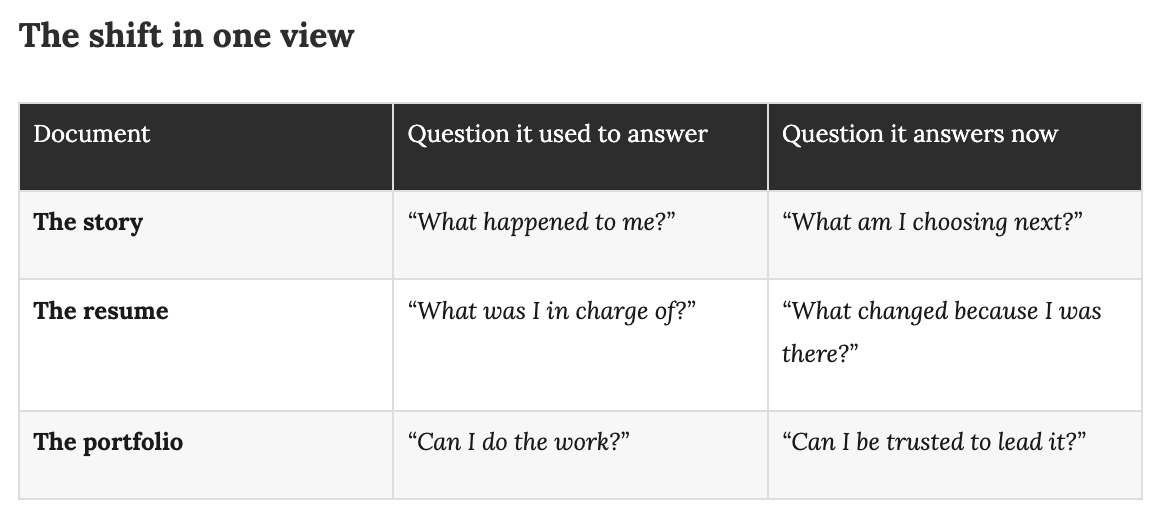
His resume, his portfolio, his whole pitch still said “I can do the work.”
Of course he could ! He’d been a director.
But a hiring panel for a leadership role isn’t asking that.
They’re asking can this person set direction, grow people, and move the business?
He had all of that evidence. Somewhere. But he just hadn’t filed any of it as leadership.
He was sending IC proof for a leadership job and reading the silence as rejection.
My strategic read: This wasn’t a confidence rebuild or a “keep going, it’s a numbers game” situation.
It was a repositioning job.
Stop the spray,
Pick a short list of companies he genuinely wanted,
Rebuild 3 career documentsso they answer the leadership question instead of the craft question.
The confidence comes back as a result of that, but it doesn’t come first.
The session: the turn
Most of the first session was him defending the spray. And that’s normal.
The volume was the only thing making him feel productive, and I was about to take it away.
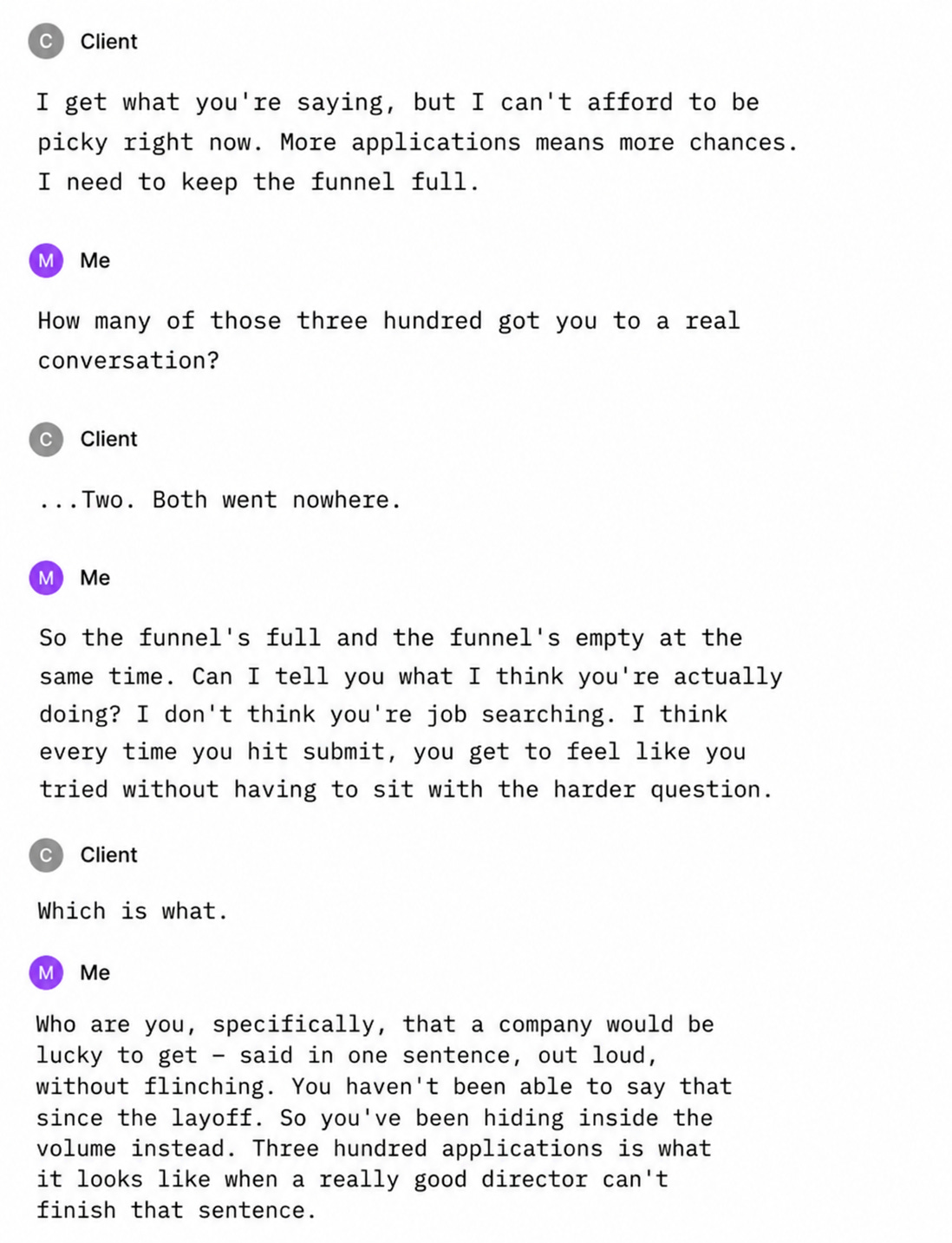
He was annoyed with me for about a minute. Then he got it.
That was the turn! Not a pep talk, the reframe that the thing keeping him busy was the thing keeping him stuck.
Once that lands, the actual work can start.
What we actually did
We threw out the “spray funnel” and replaced it with a list of 7 companies .
The companies he had a real reason to want, where his specific experience was a genuine fit.
Then we rebuilt the 3 things he’d been mass-sending, so each one answered the leadership question.
Here’s the before and after of each.
None of these “before” versions are embarrassing. They’re all competent. They’re just lost and answering the wrong question by a good person who couldn’t see himself clearly anymore.
1 → The story (how he opened any conversation).
→ Before
“So, I was at [company XYZ] for five years, got promoted to Director, and then there was a reorg and unfortunately my role got eliminated. It’s been a tough few months honestly, I’ve been applying to a lot of things. I’m open to pretty much anything at this point - director, senior IC, whatever’s the right fit.”
In other words, he led with the wound, apologized for it, and ended by telling the listener he has no idea what he wanted.
→ After
“I spent 5 years at [company XYZ] building and running design for the merchant dashboard - took it from a ticket-queue team to one that owned a $42M line, and grew the team from 4 to 11. My role was cut in a reorg last year.
I’m being deliberate about what’s next: I’m looking for a director seat where design is treated as a driver of the business, not a service desk. That’s the kind of bet I made at [company XYZ], and it’s the kind I want to make again.”
The layoff is just 1 calm sentence in the middle, named as structural, and never hidden. Now he opens with impact and closes with direction. He sounds like someone choosing, NOT someone begging.
2 → The resume.
→ Before
Led design for [product line].
Managed a team of X designers.
Shipped a redesign that improved engagement.
Partnered with PM and engineering.
Sounds accurate, but flat. Becuase it’s just a list of responsibilities - it tells you what he was in charge of, not what changed because he was there.
It’s an IC resume wearing a director’s title.
→ After
Owned design direction for [product line] ($X in revenue); set the strategy the redesign executed against and grew the team 4→11.
Made the call to invest in [bet] over [alternative] - drove engagement +18% and became the metric the CEO tracked that year.
Aligned a PM and eng org that had been stalled for two quarters; that unlock is why it shipped.
All the same projects, but every line now has altitude (a decision, a bet, a team) and a business consequence sitting next to the design outcome.
A recruiter skimming it for 10 seconds reads director, not an IC who got a title.
3 → The portfolio.
→ Before:
3 product case studies, each opening with the problem, the research, the explorations, and ending on the final screens. Beautiful, rigorous, and built exactly like the portfolio that got him promoted to Lead.
This portfolio confirmed that he “can he design.” But that’s not enough for a Director.
→ After:
A first case study titled for the leadership work—
the team he built,
the craft bar he set and held,
the bet he made and what it did to the numbers
With the product work moved behind it as evidence, NOT as the headline anymore.
The screens are still in there, but they’re now proof of his judgment instead of the subject of the presentation.
If that altitude shift sounds familiar, it’s the same machinery I broke down in the portfolio issue — the difference between answering “can you do the work” and “can you be trusted with other people’s.” For a director rebuilding cold, it’s the whole game.
All 3 changes share one move: stop sending proof that you can do the work, instead start sending proof that you can be trusted to lead it.
We packaged the targeting and the positioning into a single working document - the one that turned “apply to everything” into “win these seven.”
Here it is—
📎 ARTIFACT 1 ↴
The Positioning Wedge
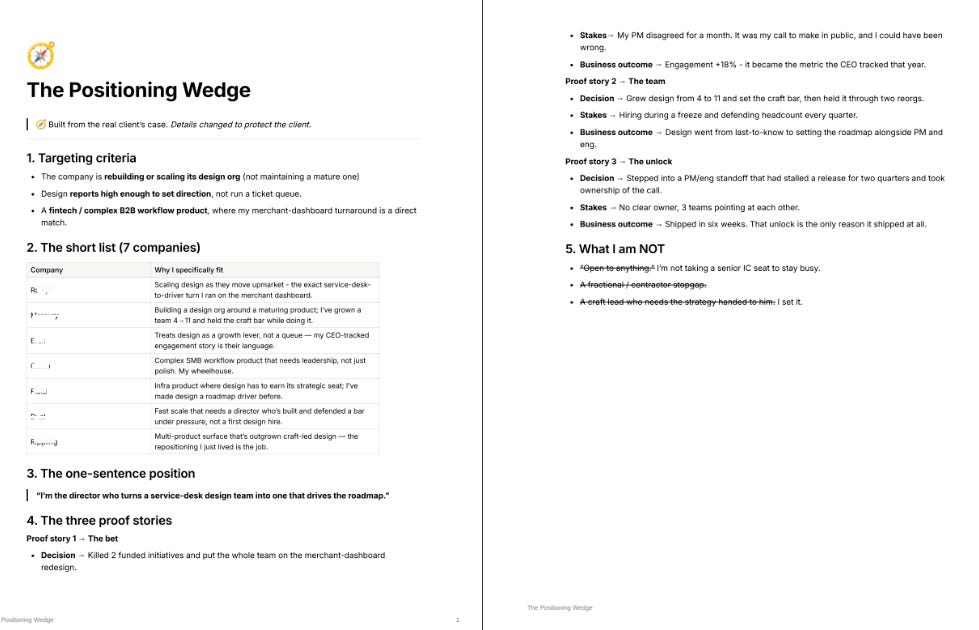
What’s on it:
The short list.
The 5–8 target companies, each with a one-line reason he specifically fit (not “they’re hiring,” but “they’re rebuilding their design org and I’ve done exactly that turnaround.”) Targeting criteria at the top so the list is repeatable, not random.
The one-sentence position.
The sentence he’d been unable to finish in our first session, now written down: “I’m the director who turns a service-desk design team into one that drives the roadmap.” Specific, ownable, repeatable by someone else.
The 3 proof stories.
The exact wins that back the sentence, each compressed to a decision, the stakes, and the business outcome. These are the stories that feed the resume, the portfolio, and every interview answer, so the whole search tells one consistent story.
What he is NOT.
The generalist “I’m open to anything” pitch, crossed out on purpose. Naming what he wasn’t selling was what made the rest land.
If you’re rebuilding after a layoff, you now have the whole front half:
stop spraying,
pick a real short list,
and rebuild your story, resume, and portfolio to answer the leadership question.
That alone will change what lands in your inbox.
But getting the interview is only half of it.
The part where most strong directors actually lose the offer happens in the room - and it’s the part he and I spent the most time on.
Behind the paywall, I hand you the exact kit he used to turn those calls into offers. Everything you get:
🎤 The Interview Rehearsal Cheat Sheet → the actual one-pager he prepped from before every call. Yours to copy.
🎯 The 5 questions that come up in every leadership interview + the “safe” answer that sinks you on each one (you’ve given all 5)
🔁 The generality → altitude swap: a real before/after that turns “I align stakeholders and communicate a clear vision” (weightless) into an answer a panel actually buys
🧱 The answer skeleton: decision → stakes → what you gave up → the number → what only you could’ve done. Fill it with your own wins and you stop freezing mid-answer
😮💨 The laid-off answer, pre-written: 3 sentences that name the layoff with zero shame — because the room takes its emotional cue from you
🛬 The “land the plane” rule that kills the “...so yeah, it was a good learning experience” trail-off for good
🧠 The real reason capable people fire off 300 applications → and why more willpower won’t fix it (this is the part almost nobody says out loud)
📌 The repositioning move underneath all of it: how to stop sending proof you can do the work and start sending proof you can be trusted to lead it
This is the stuff I usually only get into with someone paying me for the hour. Follow it, and you walk into the next interview sounding like someone they’d be lucky to get.